Galapagos Islands • Special inclusion • GAL

The Two Rivers of Justice in the Galapagos Islands

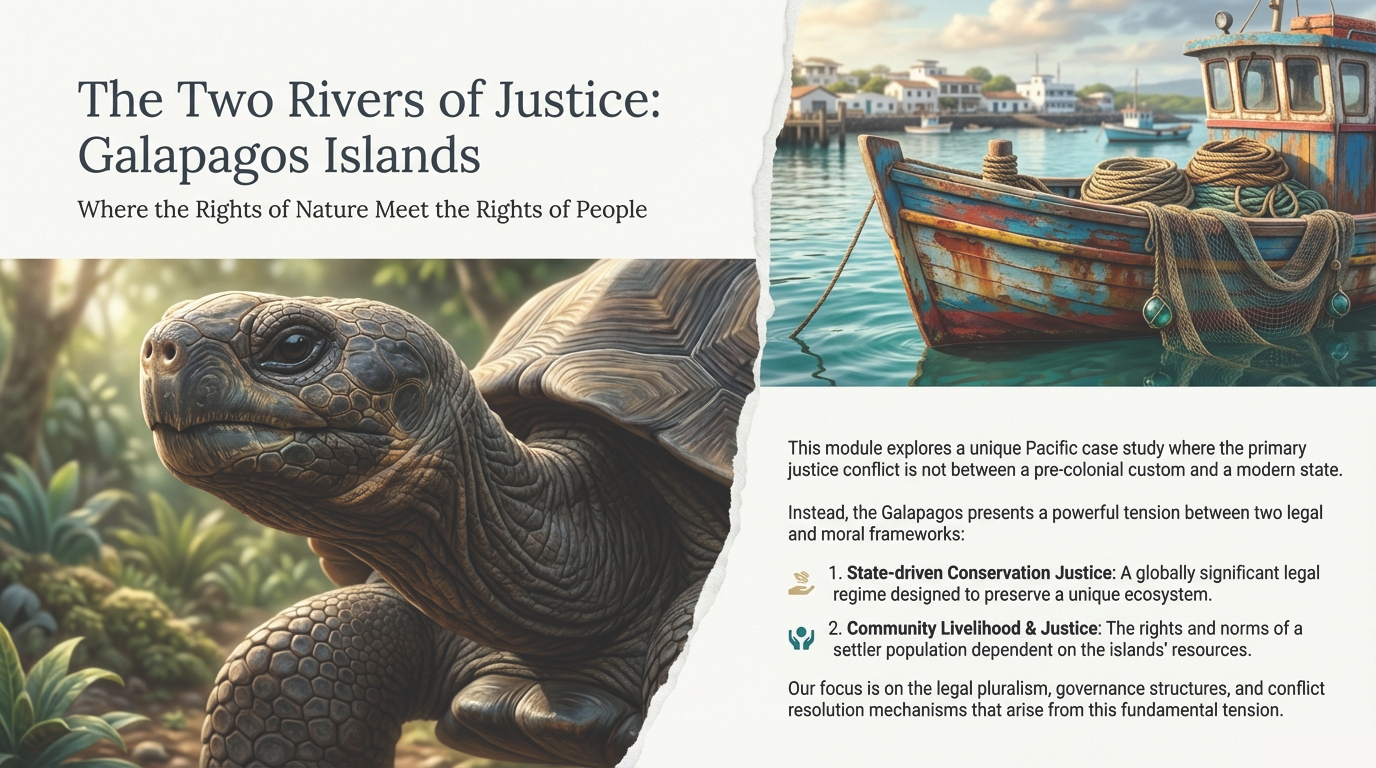
The Galapagos Islands form a unique microcosm of legal pluralism: a South American province whose residents import mainland indigenous and state traditions, while developing their own participatory systems to manage intense conflicts over marine resources and conservation.

Part of the Two Rivers of Justice – Oceania series Region: Special Inclusions & Geographic Outliers Status: Province of Ecuador; ecological and legal outlier
Start with the overview section 1 Download full country report (PDF) Best read alongside the slides, infographic and video overview.
Infographic introducing the two rivers of justice in the Galapagos Islands.
Video overview

Two Rivers of Justice — Galapagos Islands (GAL)

This short film, Galapagos – A Tale of Two Laws, walks through the key findings of the full report: the “state river” of constitutional courts and mediation, the “community river” of participatory resource management, and the collision, coexistence and integration between them.

The video is suitable for teaching, conference presentations and community briefings. It pairs with the slides and report to give a visual narrative of how legal pluralism plays out in a globally significant conservation setting.

1. Overview

Galapagos in the wider legal landscape

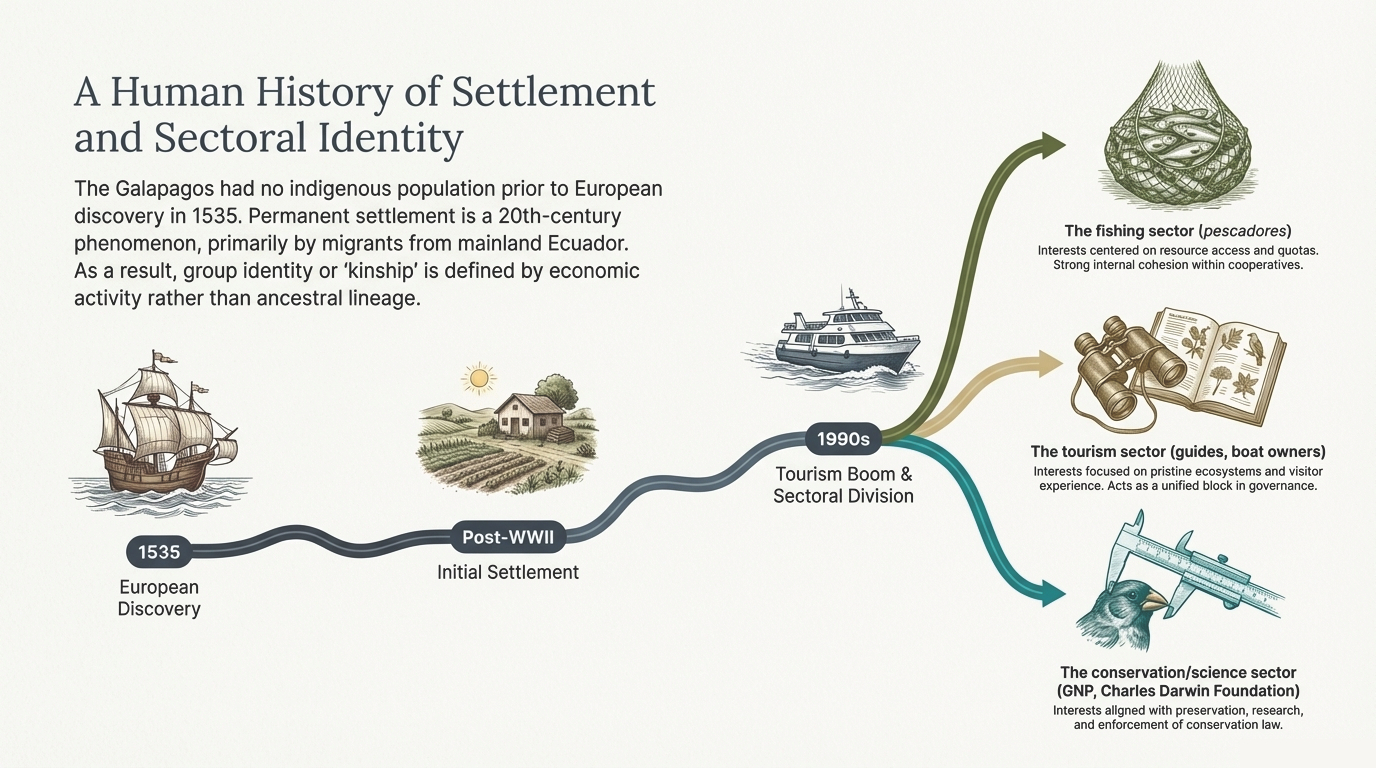
The Galapagos Islands are an Ecuadorian province and UNESCO Natural Heritage site, inhabited primarily by migrants from mainland Ecuador. There is no pre-colonial indigenous population, so the islands’ legal culture is shaped by imported mainland norms and locally created institutions that emerged from intense “resource wars” over fisheries and conservation.

The central tension for dispute resolution is between a pluralistic national constitution — which recognises both indigenous justice and state-sanctioned alternative dispute resolution — and the very practical conflicts generated by conservation policies, tourism, fishing and migration. While Kichwa and other Andean traditions travel with migrants, the key island-specific mechanisms have grown out of stakeholder negotiations over marine resources, not from a resident indigenous people.

This makes Galapagos a valuable comparative case for Oceania: it shows how legal pluralism can arise in a place without a local pre-colonial population, and how participatory institutions such as the Participatory Management Board (PMB) can function alongside, and sometimes in tension with, national courts and mainland indigenous jurisdictions.

Reading Galapagos as a “special inclusion”: although geographically tied to South America, the islands share with many Pacific jurisdictions a history of external control, conservation-driven conflicts and layered legal orders. The case therefore sits naturally within the Two Rivers of Justice – Oceania framework.
Context map and schematic of the two rivers of justice in the Galapagos Islands.
Figure 1. The “state river” and “community river” of justice in the Galapagos, flowing through collision, coexistence, integration and equality.
2. Foundations

Cultural and historical foundations

Understanding conflict in the Galapagos requires attention to both mainland cultural influences and the islands’ own history of conservation-driven disputes.

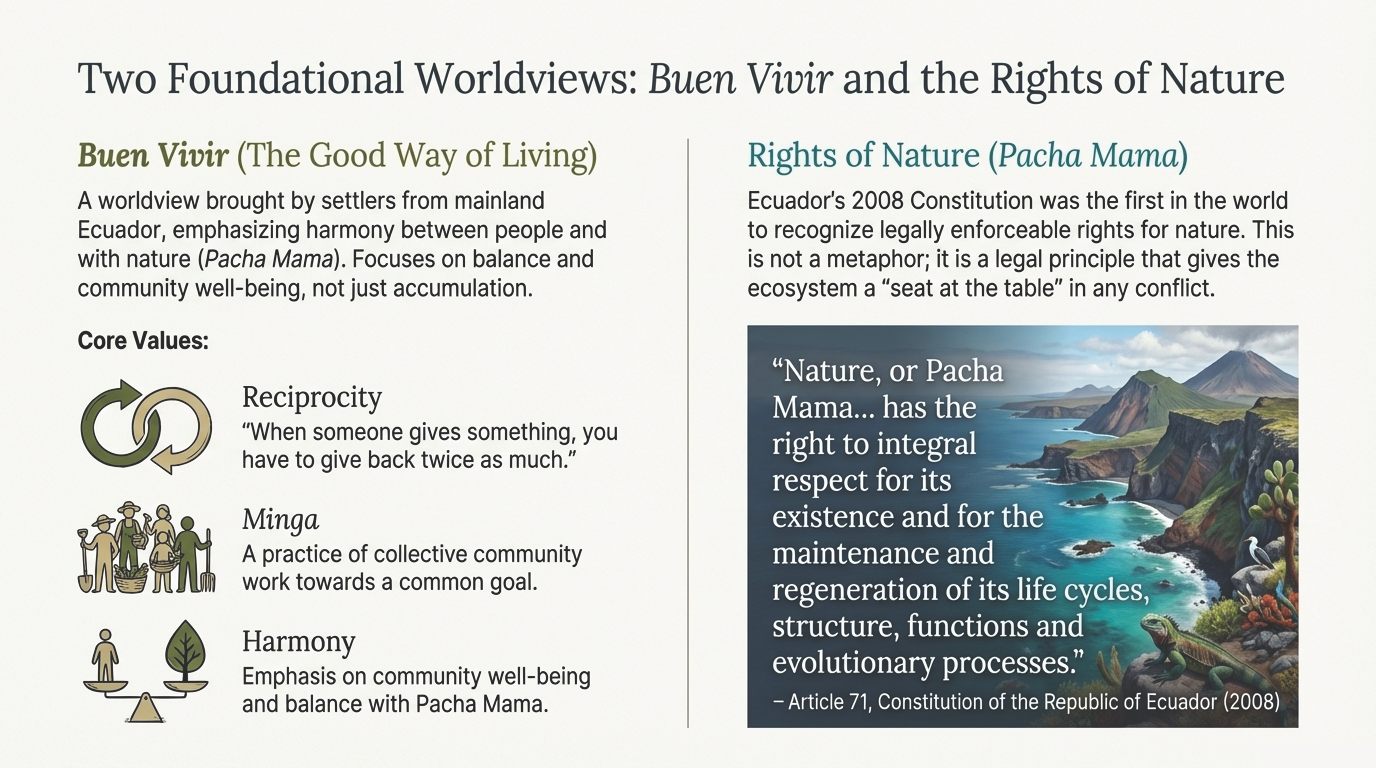
Migrants bring with them diverse mainland traditions, including Kichwa indigenous justice. That model emphasises Buen Vivir (“the good way of living”) and sees conflict as a problem for the whole community. A typical five-step sequence moves from notification and investigation through public assembly, reconciliation and finally corrective sanctions, with the goal of restoring harmony rather than punishing in an individualistic sense.

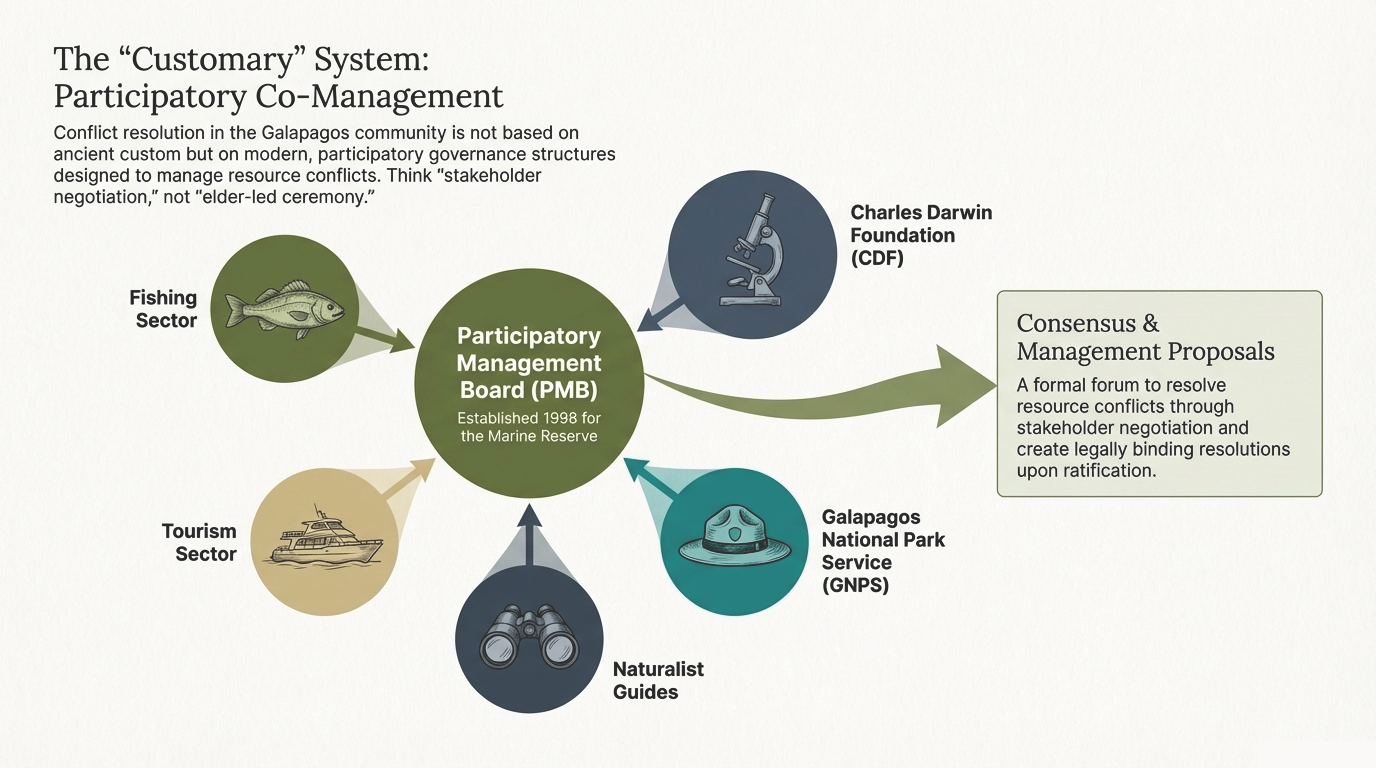
On the islands themselves, the defining historical conflicts have been over access to marine resources, especially high-value species such as sea cucumbers. Until the 1990s, a top-down conservation model excluded local fishers from meaningful decision-making, generating violent clashes and direct action. These tensions gave rise to pragmatic, participatory mechanisms – such as the Grupo Núcleo and later the Participatory Management Board – that brought fishers, tourism operators and conservation authorities into structured negotiation.

  • Imported indigenous norms emphasise reciprocity, collectivism and public accountability.
  • Island conflicts centre on livelihood–conservation tensions, not ancestral land rights.
  • Participatory institutions arose as a direct response to the failures of exclusionary conservation policy.
Timeline of Galapagos resource conflicts and the emergence of participatory management bodies.
Figure 2. From exclusionary conservation to participatory management in the Galapagos Islands.
3. Customary mechanisms

Kichwa justice and community-based norms

While there is no indigenous people native to the islands, Kichwa and other Andean traditions inform how many residents understand justice, responsibility and reconciliation.

Kichwa conflict resolution typically aims at the restoration of peace and social balance. The community assembly is central, and authorities such as elders or the cabildo investigate, convene hearings, and oversee both reproach and re-integration. Sanctions may include cold baths, community work or whipping with nettles; these are understood locally as corrective and medicinal, designed to cleanse and reintegrate the offender rather than to exclude them.

Key principles include reciprocity, collective responsibility and the public nature of proceedings: the community must witness both the wrongdoing and the resolution. Even where formal Kichwa procedures are not followed on the islands, these values influence expectations about fairness, apology and the legitimacy of authority.

  • Goal: restore harmony within the collective rather than vindicate individual rights.
  • Process: public, ritualised, and overseen by respected community authorities.
  • Sanctions: symbolic and physical acts seen as purifying and corrective, not punitive in a Western sense.
Diagram of Kichwa-inspired community justice, showing assembly, investigation, reconciliation and sanctions.
Figure 3. Mainland Kichwa justice: collective procedures that continue to shape expectations among Galapagos residents.
4. State system

Constitutional and statutory frameworks

As a province of Ecuador, the Galapagos operate within a state system that formally recognises both alternative dispute resolution and indigenous justice, while retaining strong constitutional and human rights limits.

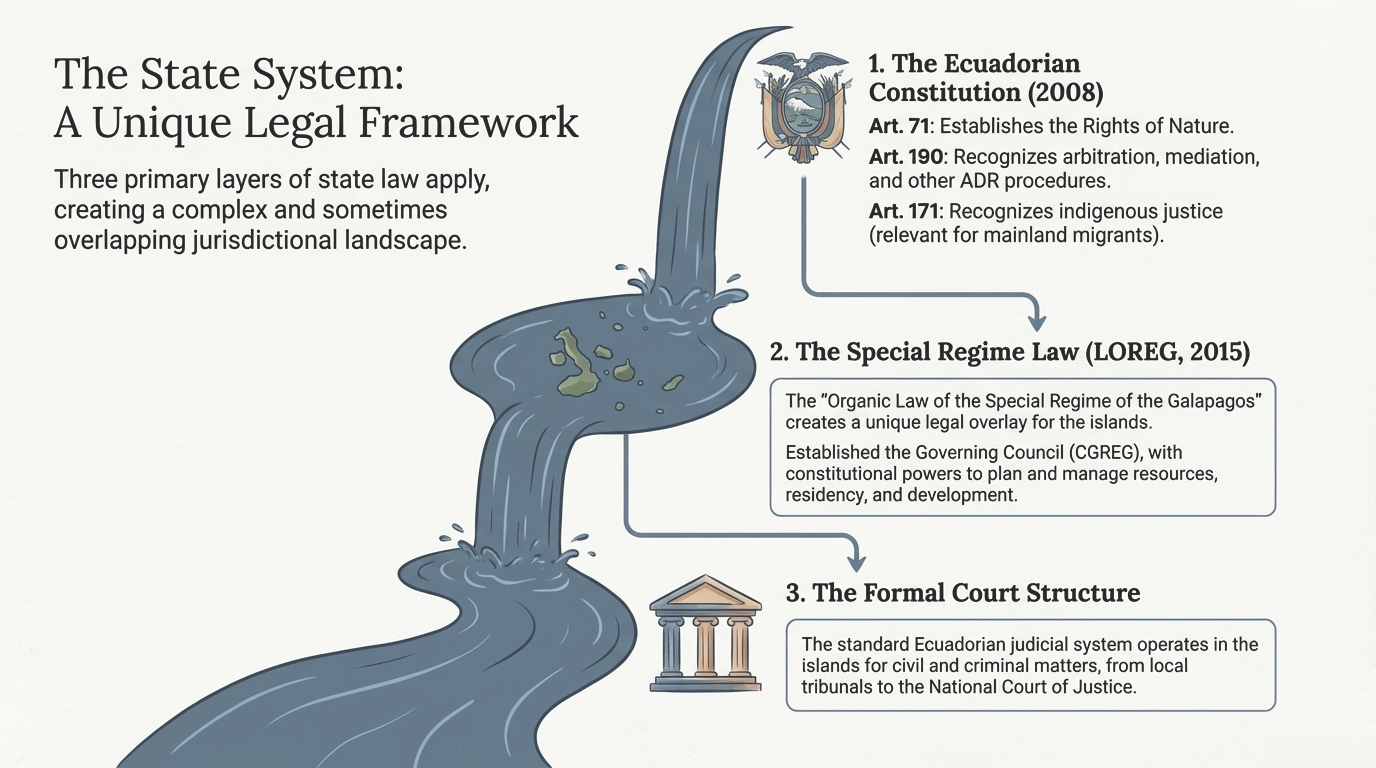
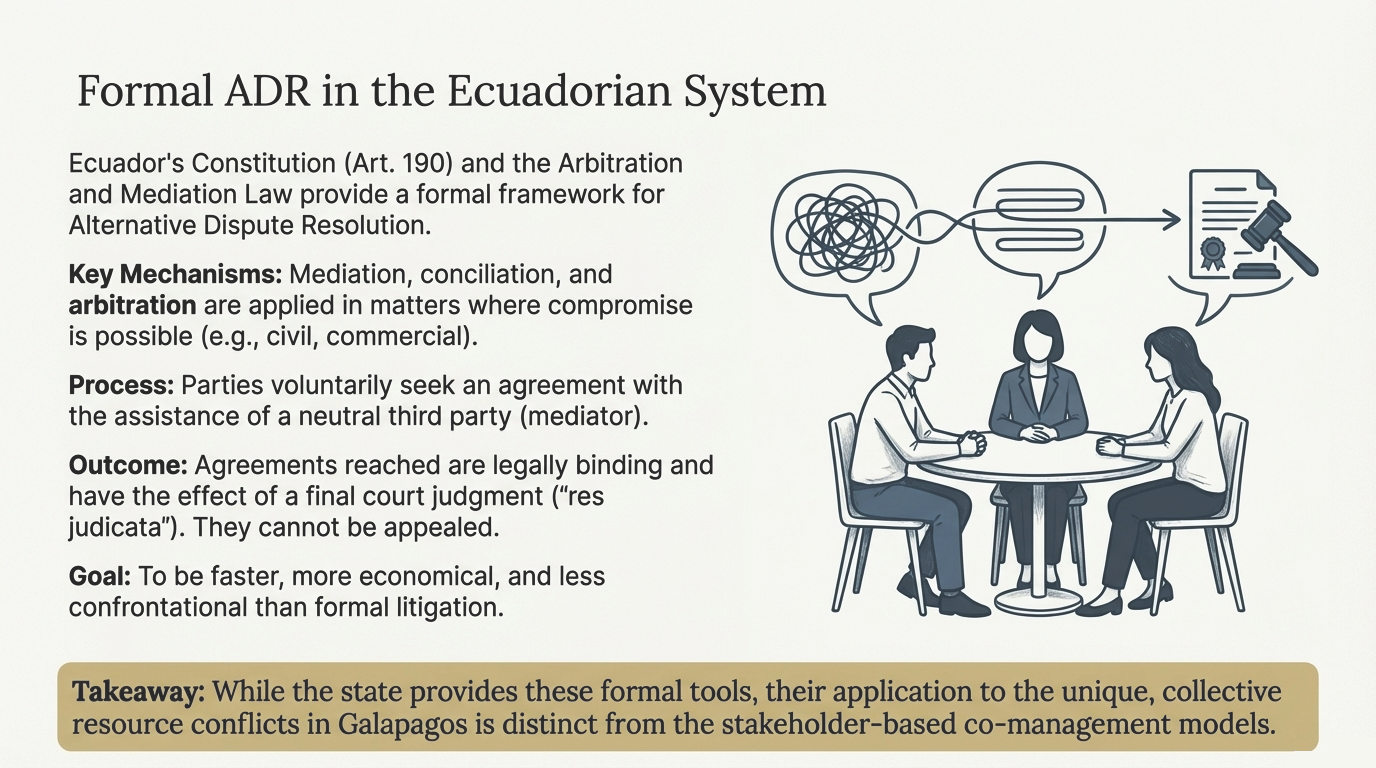
The 2008 Constitution of Ecuador is explicitly pluralist. Article 190 recognises arbitration, mediation and other alternative procedures, giving mediated agreements the force of a final judicial sentence in matters where compromise is legally permitted. Article 171 acknowledges the jurisdiction of indigenous authorities to apply ancestral legal systems to internal conflicts, subject to consistency with the constitution and international human rights norms. Article 57 reinforces collective rights, including the right to apply their own legal systems.

For the islands specifically, the Organic Law of the Special Regime of the Galapagos (LOREG) reframes governance as a socio-ecological project, prioritising conservation while mandating citizen participation. It is this framework that anchors participatory bodies for marine management and places local communities as “protagonists in decision-making” rather than passive recipients of mainland policy.

  • National ADR system: voluntary, confidential mediation with binding outcomes for suitable disputes.
  • Indigenous justice: constitutionally recognised but constrained by human rights and the absence of clear coordinating legislation.
  • Special regime: LOREG shifts the islands from strict preservationism to participatory socio-ecological governance.
Diagram of Ecuadorian courts, ADR mechanisms and Galapagos special regime institutions.
Figure 4. The state “river”: courts, ADR centres and the special Galapagos regime operating within Ecuador’s pluralist constitution.
5. Legal pluralism

Where the rivers meet — and collide

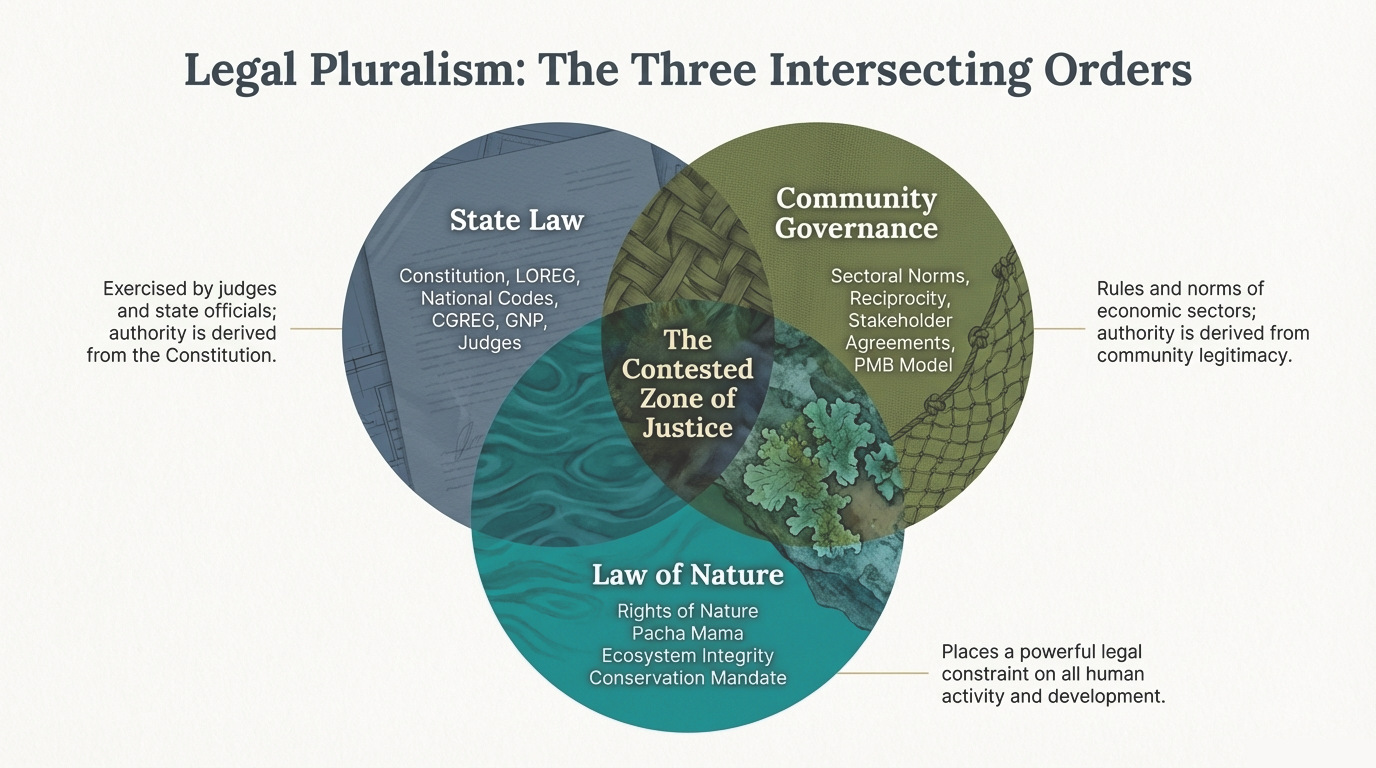
Ecuador’s recognition of both indigenous justice and state courts produces a complex landscape of “interlegality”, where different systems overlap, interpenetrate and sometimes clash.

Although the constitution grants indigenous authorities jurisdiction over internal conflicts, there is no detailed legislation clarifying who counts as subject to that jurisdiction, what “internal” means, or how proceedings in one system should be recognised in the other. This creates uncertainty for communities, state officials and individuals who may be accountable to both orders at once.

The La Cocha–Guantópolo case illustrates the problem starkly: after a homicide, indigenous authorities applied customary sanctions, including whipping, only for state prosecutors to later imprison both the suspects and community leaders for the same events. The Constitutional Court case that followed highlights the risk of double jeopardy, conflicting interpretations of human rights, and deep uncertainty about how far indigenous jurisdiction extends.

  • Jurisdictional ambiguity encourages forum-shopping but exposes communities to legal risk.
  • “Internal conflict” remains undefined, especially for serious crimes.
  • Customary sanctions may be seen as corrective locally but as cruel or degrading in international human rights law.
Graphic showing collision, coexistence, integration and equality between state and community rivers of justice in the Galapagos.
Figure 5. Collision, coexistence, integration and equality between state courts, indigenous justice and participatory governance.
6. Comparison

Comparing Galapagos models with Western mediation

The full report compares three key models: Kichwa customary justice, the Galapagos participatory model (e.g. Grupo Núcleo) and Western facilitative mediation as practised in places such as Australia.

Kichwa justice is collectivist and restorative, led by community authorities and embedded in ritualised public proceedings. The Galapagos participatory model is also collectivist but more technocratic: multi-stakeholder workshops with agreed ground rules, where representatives craft proposals that are then ratified by their “bases”. By contrast, Western facilitative mediation is individualistic, private and rights-neutral, focused on helping parties reach a confidential settlement that meets their personal needs.

The analysis highlights not only differences in process, but in the underlying concept of resolution itself. For Kichwa and participatory models, the aim is the restoration of relationships and social equilibrium; for Western mediation, the aim is an enforceable end-point to the dispute. These divergent goals shape how authority, confidentiality and community involvement are understood.

Practice implication: borrowing techniques from Western mediation without adapting them to collectivist, participatory contexts risks undermining local legitimacy and producing agreements that appear sound on paper but fail in practice.
Comparison matrix of customary, participatory and Western facilitative mediation models.
Figure 6. Core attributes of Kichwa, Galapagos participatory and Western facilitative mediation models.
7. Practice

Implications for mediators and practitioners

The report frames guidance for practitioners through the lens of “Adaptive Mediation” – a flexible, context-driven approach grounded in complexity theory.

Key risks for mediators include imposing individualistic solutions in contexts where community harmony is paramount; overlooking the importance of reciprocity; underestimating the authority of elders and local leaders; and ignoring the parallel claims of customary law when crafting agreements.

Adaptive practice begins with careful pre-mediation context analysis: mapping cultural backgrounds, power dynamics, and whether collective interests are at stake. Processes can then be co-designed with parties, often using multi-stage decision-making in which provisional agreements are taken back to families or stakeholder groups for consultation and ratification. Respectful involvement of community authorities – as advisors or supporters rather than imposed decision-makers – helps ensure cultural congruence without sacrificing fairness.

  • Co-design processes rather than importing a “one size fits all” mediation model.
  • Re-examine confidentiality: some disputes require a degree of public acknowledgment to restore social harmony.
  • Anchor agreements in both state law and community norms to avoid creating new layers of conflict.
Practice-oriented slide summarising adaptive mediation strategies for Galapagos.
Figure 7. Adaptive mediation strategies for working with Galapagos communities and institutions.
8. Case studies

Illustrative case studies and scenarios

The report uses both mainland and island examples to show how plural legal orders interact in practice.

Case study A

La Cocha–Guantópolo homicide and dual jurisdiction

Andean highlands, 2010 – Constitutional Court of Ecuador

Indigenous authorities, acting under their understanding of constitutional autonomy, applied customary sanctions including whipping to five homicide suspects. State prosecutors later initiated a separate criminal case, imprisoning both the suspects and community leaders for administering the punishment. The resulting Constitutional Court proceedings exposed the absence of coordinating legislation, the risk of double jeopardy, and the deep value conflicts between community conceptions of purification and national human rights standards.

Case study B

Sea cucumber conflicts and the Participatory Management Board

Galapagos Marine Reserve, 1990s–2000s

Intense disputes over lucrative sea cucumber fisheries pitted local fishers against conservation authorities enforcing strict extraction limits. After protests and violent clashes, the state moved from a purely top-down model to the Grupo Núcleo and later the Participatory Management Board, bringing fishers, tourism operators and scientists into structured decision-making. While conflict did not disappear, these bodies became key arenas for negotiation, illustrating how participatory mechanisms can transform zero-sum resource struggles into ongoing, adaptive co-management.

9. Conclusion

Key lessons from the Galapagos Islands

Galapagos shows how legal pluralism, participatory governance and conservation politics intersect in a small but globally significant jurisdiction.

The islands demonstrate a dual movement in conflict management: from imported indigenous and state traditions, and from locally crafted participatory mechanisms born in the heat of resource conflict. Together, these arrangements anticipate global theories of Adaptive Co-Management, showing how stakeholder learning, trust and collaboration can be institutionalised without erasing deep differences in values and world-views.

For practitioners in Australia and across Oceania, the Galapagos case underscores the limits of one-size-fits-all dispute resolution models. Effective practice requires culturally aware, context-specific processes that respect local expectations of reciprocity, community involvement and the shared stewardship of land and sea. In that sense, this South American outpost speaks directly to the challenges and opportunities faced by island communities throughout the Pacific.