Fiji • Melanesia • FJI

The Two Rivers of Justice in Fiji

Fiji’s justice landscape is built on two intertwined systems: a customary river grounded in village leadership, reconciliation ceremonies and talanoa dialogue, and a state river based on the 2013 Constitution and Western common law. This page translates the country study into a practice-focused overview for mediators, lawyers and justice professionals.

Part of the Two Rivers of Justice – Oceania series Region: Melanesia Status: Sovereign State (Republic of Fiji)
Start with the overview section 1 Download full Fiji report (PDF) Best read together with the slides, infographic and video overview.
Infographic showing Fiji’s dual justice system, with customary and formal rivers of justice.
Video overview

Fiji’s Dual Justice System – Video Introduction

This short film introduces Fiji’s dual justice system, moving between the customary river—chiefs’ councils, village headmen and reconciliation ceremonies— and the formal river of courts, statutes and Western-style mediation.

The video can be used as a teaching resource in mediation training, judicial education and cross-cultural negotiation workshops, or as a primer for practitioners new to Fijian dispute-resolution practices.

1. Overview

Fiji in the Melanesian legal landscape

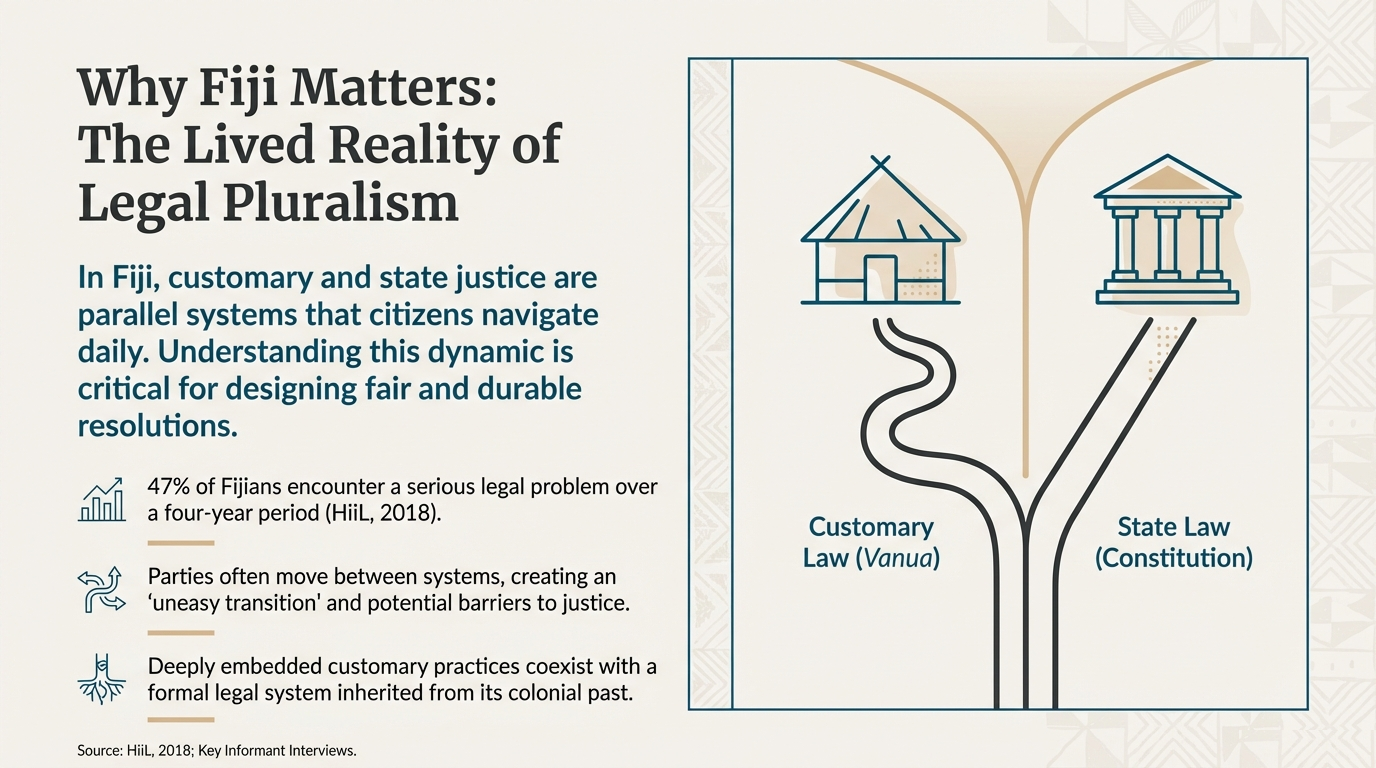
Fiji is a multi-ethnic island state whose people routinely move between customary and formal justice institutions when facing serious problems. Almost half of all Fijians report encountering a significant legal issue over a four-year period, often involving land, family and community disputes.

The country’s social fabric is shaped primarily by two communities: indigenous iTaukei (taukei) and Indo-Fijians whose ancestors arrived as indentured labourers under British rule. Customary land tenure is central: around 84 percent of land is held under native title, with most of that administered through the iTaukei Land Trust Board (TLTB). As a result, land and resource disputes are among the most common and sensitive conflicts.

Everyday dispute-resolution therefore takes place along two paths. At village and community level, people rely on local leaders, chiefs’ councils and reconciliation rituals to restore harmony. In parallel, the Constitution, courts and a growing ADR sector offer rights-based avenues for civil, commercial and criminal matters. For practitioners, understanding how people move between these paths is critical for designing processes that are both effective and culturally safe.

Key idea: Fiji’s legal pluralism is not an abstract theory but a lived reality in which citizens, police and officials routinely shuttle matters between customary forums and state institutions.
Slide summarising Fiji’s pluralistic legal landscape and prevalence of legal problems.
Figure 1. Fiji’s pluralistic legal landscape, highlighting high justice needs and the dual system of dispute resolution.
2. Foundations

Historical and constitutional bedrock

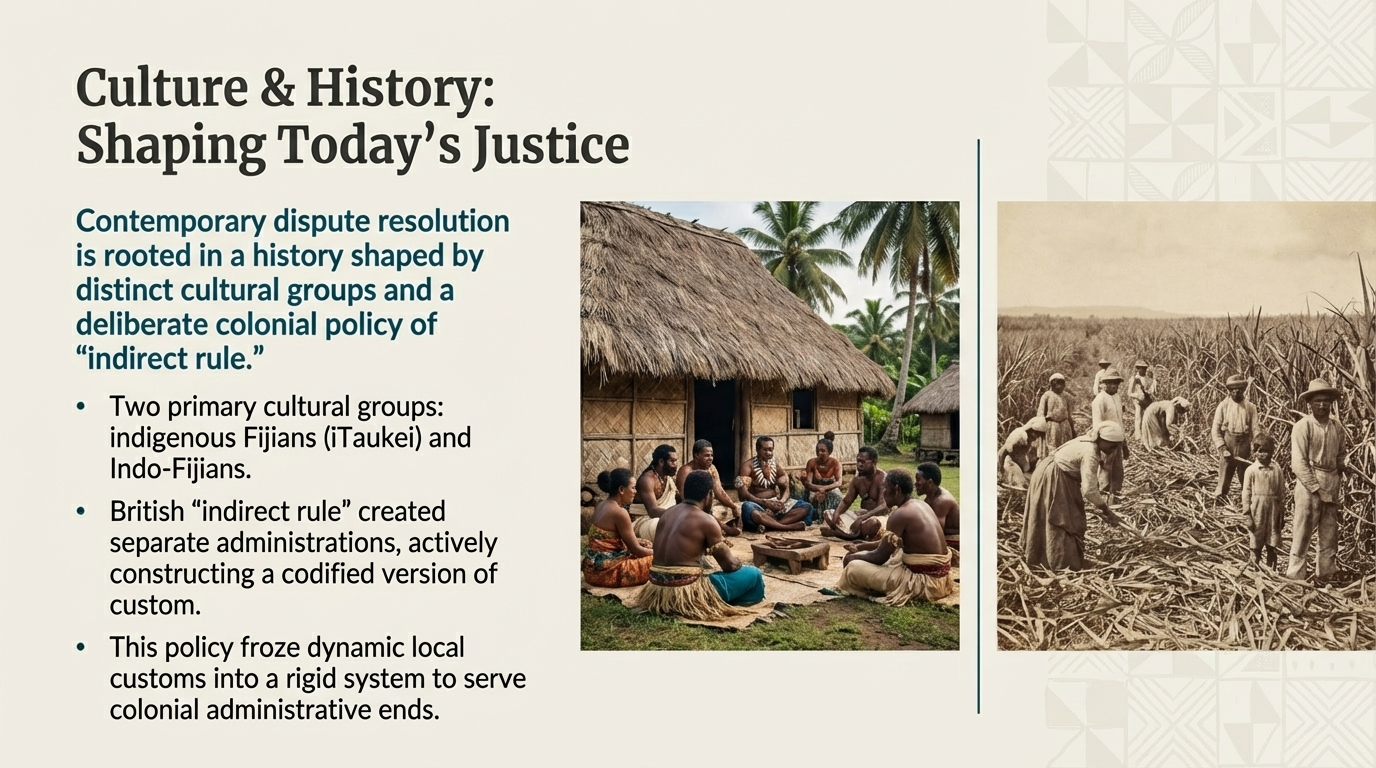
Contemporary dispute-resolution in Fiji rests on the interaction between indigenous institutions, a colonial legacy of indirect rule and a modern constitution that affirms individual rights while accommodating custom.

Under British administration, taukei governance structures were preserved and hardened through a policy of indirect rule. Customary land was protected from sale, but at the cost of freezing dynamic practices into codified categories and separating taukei and Indo-Fijian communities in law and administration. This history continues to shape present-day conflicts, especially around land and political power.

The 2013 Constitution now stands as the supreme law. It establishes an independent judiciary, guarantees basic rights and creates key institutions such as the Human Rights and Anti-Discrimination Commission and the Legal Aid Commission. The courts follow a familiar hierarchy—Magistrates’ Courts, High Court, Court of Appeal and Supreme Court—providing avenues for review and appeal in most areas of law.

  • Colonial policies entrenched separate administrative paths for taukei and Indo-Fijians, with enduring consequences for land and identity.
  • The Constitution affirms a rights-based framework while leaving space for the consideration of customary practices in certain contexts.
  • Judicial and commission structures provide formal safeguards, but access and cultural fit remain uneven across communities.
Timeline slide tracing Fiji’s colonial history, land policies and constitutional developments.
Figure 2. Historical milestones from British indirect rule to the 2013 Constitution and contemporary ADR reforms.
3. Customary mechanisms

Village leadership, bulubulu and talanoa

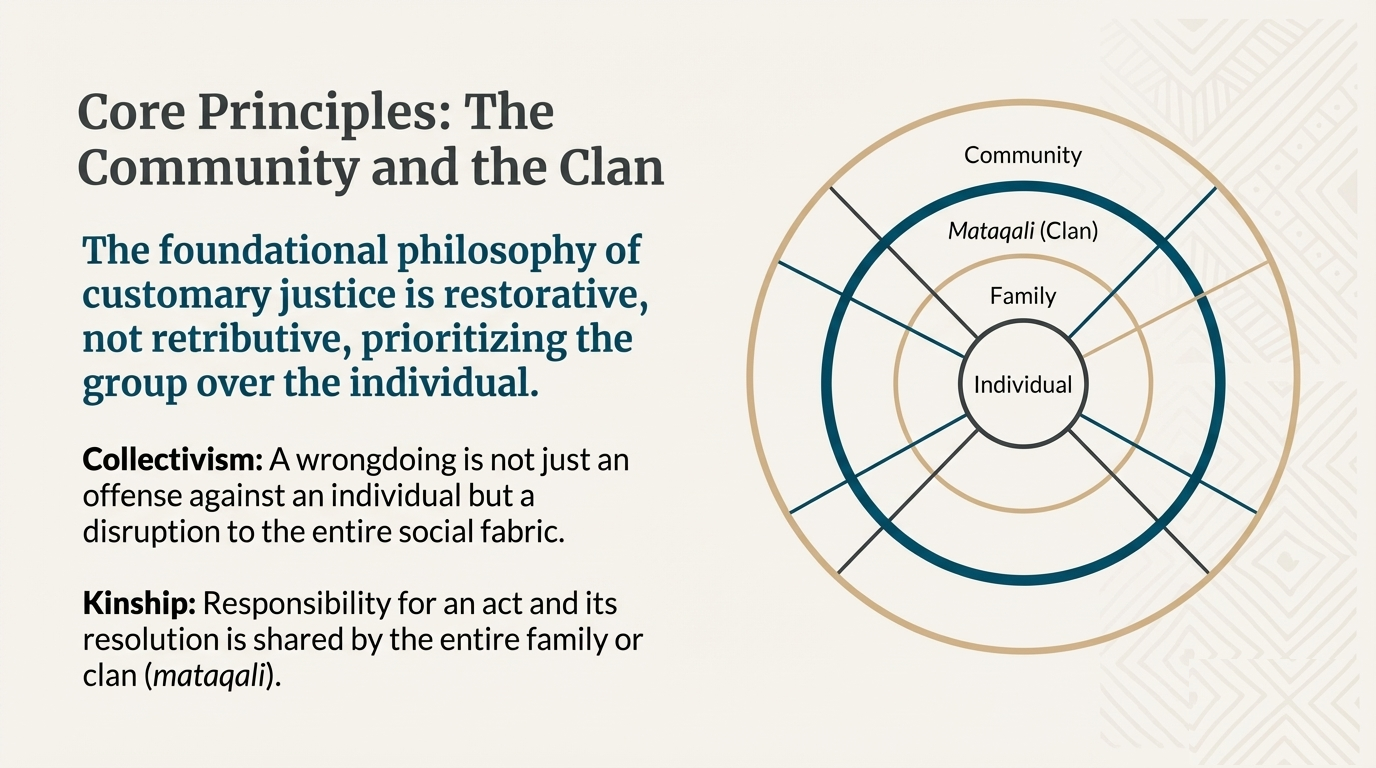
Customary practices in Fiji are profoundly restorative: they prioritise mending relationships and restoring communal harmony over determining individual legal rights.

At community level, disputes usually begin with the turaga ni koro (village headman), who facilitates early dialogue and may resolve minor conflicts before they escalate. More serious matters are brought before chiefs and councils of elders, who combine facilitation with decision-making authority. Their role is hierarchical and imbued with cultural and spiritual legitimacy.

Formal reconciliation ceremonies, most notably bulubulu, involve apology, ritual presentation of gifts such as the tabua (whale’s tooth) and public affirmation of forgiveness. In parallel, talanoa dialogue provides a more informal, story-driven mode of discussion aimed at achieving consensus in a relational, high-context way.

  • Objective: restore harmony and reintegrate parties into the community rather than punish offenders.
  • Responsibility is often shared by the wider family or mataqali, not just the individual who committed the wrong.
  • Processes are typically public, relational and deeply embedded in ongoing social ties.
Diagram of Fijian customary dispute-resolution mechanisms, including turaga ni koro, chiefs and bulubulu.
Figure 3. Key customary mechanisms: village headmen, chiefs’ councils, reconciliation rituals and talanoa dialogue.
4. State system

Courts, commissions and ADR programmes

Alongside custom, Fiji maintains a sophisticated state justice system and a growing ecosystem of alternative dispute-resolution initiatives inspired by international practice.

The formal courts handle most criminal and civil matters, supported by specialised institutions such as the Native Lands Commission (NLC), which determines customary land ownership, and the iTaukei Land Trust Board, which administers leases over native land. The Small Claims Tribunal provides a simplified venue for low-value civil disputes, while the Legal Aid Commission improves access to representation for people of limited means.

Fiji has also invested in ADR. The Fiji Mediation Centre offers professional mediation services; the Fiji Revenue & Customs Service operates an ADR framework for tax disputes; and court-annexed mediation is integrated into civil litigation. The International Arbitration Act 2017 signals Fiji’s ambition to act as a regional hub for commercial arbitration.

  • Formal institutions provide clear appellate pathways and align with global standards in many areas, especially commerce.
  • Specialised land and customary-law bodies operate partly outside the ordinary courts, creating parallel pathways for core issues like land tenure.
  • ADR initiatives reflect a shift toward negotiated and mediated solutions within the state river of justice.
Slide mapping Fiji’s formal justice system, courts and ADR institutions.
Figure 4. The state river of justice: courts, statutory bodies and a modern ADR framework.
5. Legal pluralism

Where the rivers meet – and collide

Fiji’s customary and state systems intersect in complex ways. Some points of formal recognition have become sources of friction, especially where communal harmony and individual rights pull in different directions.

Statutes such as the iTaukei Affairs Act encourage traditional reconciliation for maintaining peace, and courts may consider bulubulu as a mitigating factor in sentencing. At the same time, judicial practice increasingly rejects reconciliation as determinative in serious domestic-violence cases, emphasising protection of victims and constitutional rights.

The Native Lands Commission illustrates both recognition and limitation. Its decisions on customary land ownership are designated “final and conclusive,” not reviewable by the ordinary courts. This protects customary tenure but denies indigenous landowners access to due-process safeguards and appeal rights available elsewhere in the legal system. Conflicts also arise where legally adopted children are recognised in state registers but not in customary land registers, so they cannot inherit customary land rights.

  • Domestic-violence cases expose sharp tensions between communal pressure to reconcile and the state’s duty to protect vulnerable parties.
  • Finality of administrative decisions over land strengthens custom but can generate an “accountability gap” in relation to rights of appeal.
  • Contradictions between statutory and customary concepts of status (e.g. adoption) create real-world injustice for affected individuals.
Infographic highlighting key frictions between customary and state systems: domestic violence, land disputes and inheritance.
Figure 5. Points of collision: domestic violence, land disputes and inheritance contradictions.
6. Comparison

Customary practices and Western mediation side by side

The Fiji study compares local practices with Australian/Western mediation models across core values, roles, process and outcomes. The differences go well beyond procedure; they reflect distinct worldviews.

Fijian customary processes focus on collective harmony and relationship repair. Elders, chiefs and the village headman act as respected authorities who may both facilitate and decide. Processes are often public, dialogue-based and embedded in social relations, with consensus, authority-based decisions and restorative acts such as bulubulu as common outcomes.

By contrast, Western mediation emphasises individual autonomy and contractual finality. Mediators are neutral third parties with no stake in the outcome. Confidentiality, neutrality and voluntariness are formal cornerstones, and communication is typically low-context and direct. Outcomes take the form of written settlement agreements resolving a defined dispute, without necessarily preserving ongoing relationships.

Practice implication: Transplanting a standard Western model into Fijian settings without adaptation risks misunderstanding, offence and escalation, even when everyone is acting in good faith.
Comparison matrix contrasting features of Fijian customary practices with Australian/Western mediation.
Figure 6. Comparative matrix: core values, third-party roles, communication styles and outcome formation in the two models.
7. Practice

Guidance for mediators and justice practitioners

Working with people from Fiji requires a shift from a task-centred to a relationship-centred approach, together with a willingness to adapt process architecture while maintaining core safeguards.

The report emphasises a set of cultural sensitivities: high-context communication, the primacy of relationships, the importance of respect and “face,” and the fact that individuals often speak on behalf of wider kin groups. Mediators must avoid reading politeness as agreement or silence as consent, and should anticipate periods of consultation with absent family members.

Effective practice includes investing time in relational talk, using caucuses as safe spaces for more direct conversation, and—where parties agree—inviting elders or respected supporters to participate. Elements that mirror familiar practices, such as narrative storytelling or formal apologies, can be incorporated into a structured mediation while still honouring confidentiality and fairness obligations.

  • Prioritise rapport-building and cultural humility before moving into problem-solving.
  • Design flexible processes that allow for talanoa-style storytelling, the presence of elders and consideration of symbolic gestures.
  • Guard against coerced reconciliation in cases involving power imbalances, particularly gender-based violence.
Practice-focused slide offering guidance for international mediators working in Fiji.
Figure 7. Practical guidance for international mediators engaging with Fijian parties.
8. Case studies

Illustrative scenarios

The following composite examples draw together common themes from reported cases and field research. They are designed for use in training and reflective practice.

Case study A

Land-lease dispute within a mataqali

Customary landowning unit, TLTB and commercial lessee

A mataqali is divided over whether to renew a tourism lease administered by the TLTB. Some members prioritise income, others fear environmental damage and loss of cultural sites. Initial meetings with the TLTB representative fail, as younger members feel unheard. A hybrid process is designed: chiefs and elders host a talanoa series on the land itself, followed by facilitative mediation sessions involving TLTB officers and the lessee. The final arrangement re-scopes the lease, protects key cultural areas and provides a transparent benefit-sharing formula. The example illustrates how state and customary actors can jointly craft solutions when given time and appropriate process architecture.

Case study B

Domestic-violence matter referred from village to court

Married couple, extended family and Magistrates’ Court

After a serious assault, the woman’s family and village leaders initiate bulubulu to preserve family unity. The police, however, proceed with criminal charges under the Domestic Violence Act. During sentencing, the court hears evidence of reconciliation but treats it only as a minor mitigating factor, emphasising the need for deterrence and victim protection. The court also notes that the victim’s consent to reconciliation was constrained by family pressure. This scenario highlights the limits of customary settlement in areas where the state has determined that public-interest and rights-based considerations must prevail.

9. Conclusion

Key messages from Fiji

Fiji demonstrates both the strengths and the tensions of legal pluralism in Oceania. Its experience speaks directly to regional debates on how customary and state systems can coexist without compromising justice.

The Fijian case confirms that pluralism can offer citizens multiple pathways to resolution, but also that these pathways are not always compatible. Customary mechanisms excel at restoring relationships within close-knit communities, while the formal system is better equipped to safeguard rights and manage complex commercial and constitutional questions.

For practitioners in Australia and other parts of the world, Fiji underscores the necessity of cultural competence and procedural flexibility. Effective engagement requires understanding both rivers, recognising when each is appropriate, and designing processes that neither romanticise custom nor impose Western models uncritically. Done well, this work can help parties achieve outcomes that are not only legally sound but also socially and culturally meaningful.