Vanuatu • Melanesia • VUT

The Two Rivers of Justice in Vanuatu

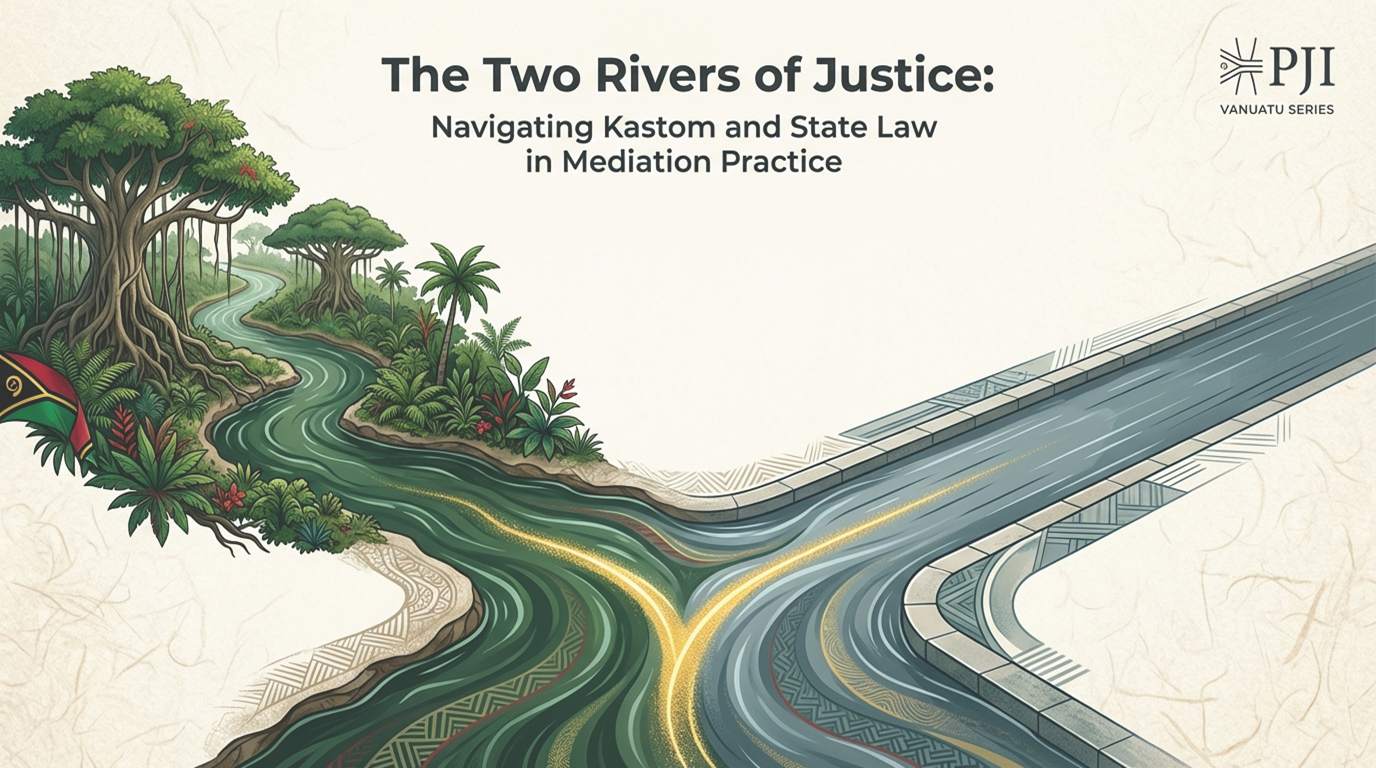
Vanuatu’s justice is carried by two powerful currents: kastom – the living customary order embedded in village life – and the formal state system shaped by Anglo-French colonial rule and modern constitutional law. For most ni-Vanuatu, justice is first and foremost a local, communal practice, not a distant function of the state.:contentReference[oaicite:1]{index=1}

Part of the Two Rivers of Justice – Oceania series Region: Melanesia Status: Independent republic (since 1980)
Title slide showing Vanuatu’s kastom, church and state as three pillars, with two rivers of justice flowing through islands of the archipelago.
Video overview

Vanuatu’s Dual Worlds of Justice

This short film introduces Vanuatu’s “dual worlds” of kastom and state law, explaining how chiefs, church leaders and courts share – and sometimes contest – authority over everyday disputes.

Replace the embed ID below with the YouTube ID for Vanuatu’s Dual Worlds once uploaded.

1. Overview

A linguistically dense archipelago of plural justice

Vanuatu is a chain of 83 islands with at least 113 indigenous languages – the highest language density per capita in the world. That diversity is mirrored in its justice practices: kastom, church and state form three interlocking pillars of authority.:contentReference[oaicite:2]{index=2}

Independence in 1980 created a modern republic sitting atop a much older customary order and the legacy of the Anglo-French Condominium. For most rural ni-Vanuatu – around three-quarters of the population – chiefs, elders and kastom forums remain the primary and most trusted way to resolve conflict. Police and courts are often distant, expensive and culturally unfamiliar.

The report emphasises that justice in Vanuatu is best understood as social maintenance rather than state enforcement: a collective, restorative practice aimed at keeping relationships, land and community in balance.:contentReference[oaicite:3]{index=3}

For practitioners: any intervention that ignores kastom or treats it as a mere “add-on” to state law is likely to misread both how disputes arise and how communities expect them to be dealt with.
Map and infographic showing Vanuatu’s islands, languages and the three pillars of government, kastom and church.
Figure 1. Vanuatu in Melanesia: an archipelago of many languages, kastom systems and overlapping authorities.
2. Foundations

From pre-colonial kastom to condominium and independence

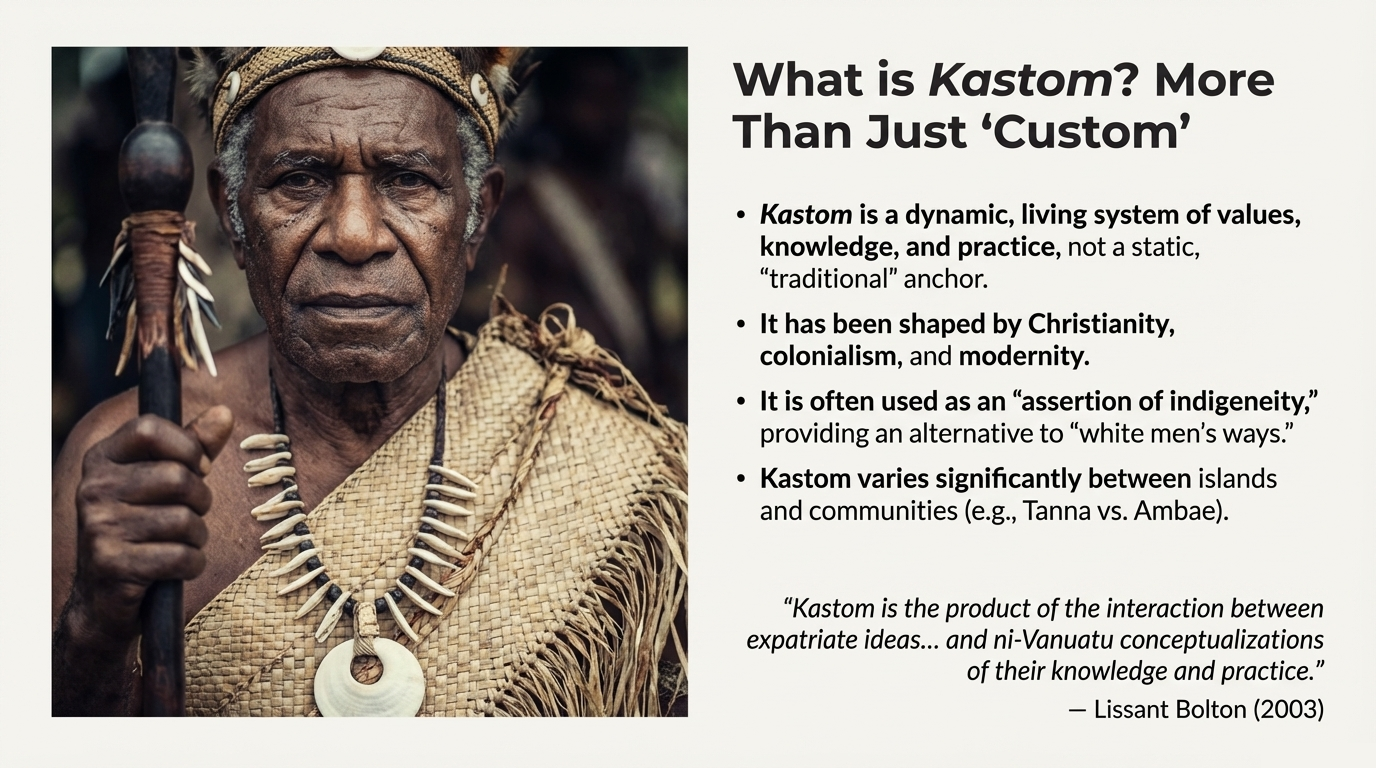
Kastom in Vanuatu is a living system, not a museum piece. It has adapted through missionary activity, Anglo-French rule and the creation of a modern constitution, while remaining central to identity and authority.:contentReference[oaicite:4]{index=4}

Pre-colonial societies relied on kinship, reciprocity and spiritual sanction to keep order. Wrongdoing was treated as a rupture in relationships, not as an offence against an abstract “state”. Chiefs, where they existed, led through consensus and persuasive authority. In some areas the role of “chief” was formalised only in the colonial period, yet it is now firmly embedded in kastom leadership.

The Anglo-French Condominium superimposed parallel British and French systems without integrating them with indigenous norms. This “two governments” history left a legacy of legal pluralism and fragmentation that continues to shape how ni-Vanuatu view state law today.

  • Kastom is relational and collective, aimed at restoring harmony.
  • Churches now sit alongside chiefs as powerful moral authorities.
  • State institutions were added late and remain comparatively brittle and under-resourced.
Timeline showing pre-colonial kastom, Anglo-French Condominium and independence, with the emergence of today’s tripartite structure.
Figure 2. Historical layers: kastom, churches and the Anglo-French dual administration feeding into the 1980 Constitution.
3. Customary mechanisms

Kastom, nakamal and reconciliation

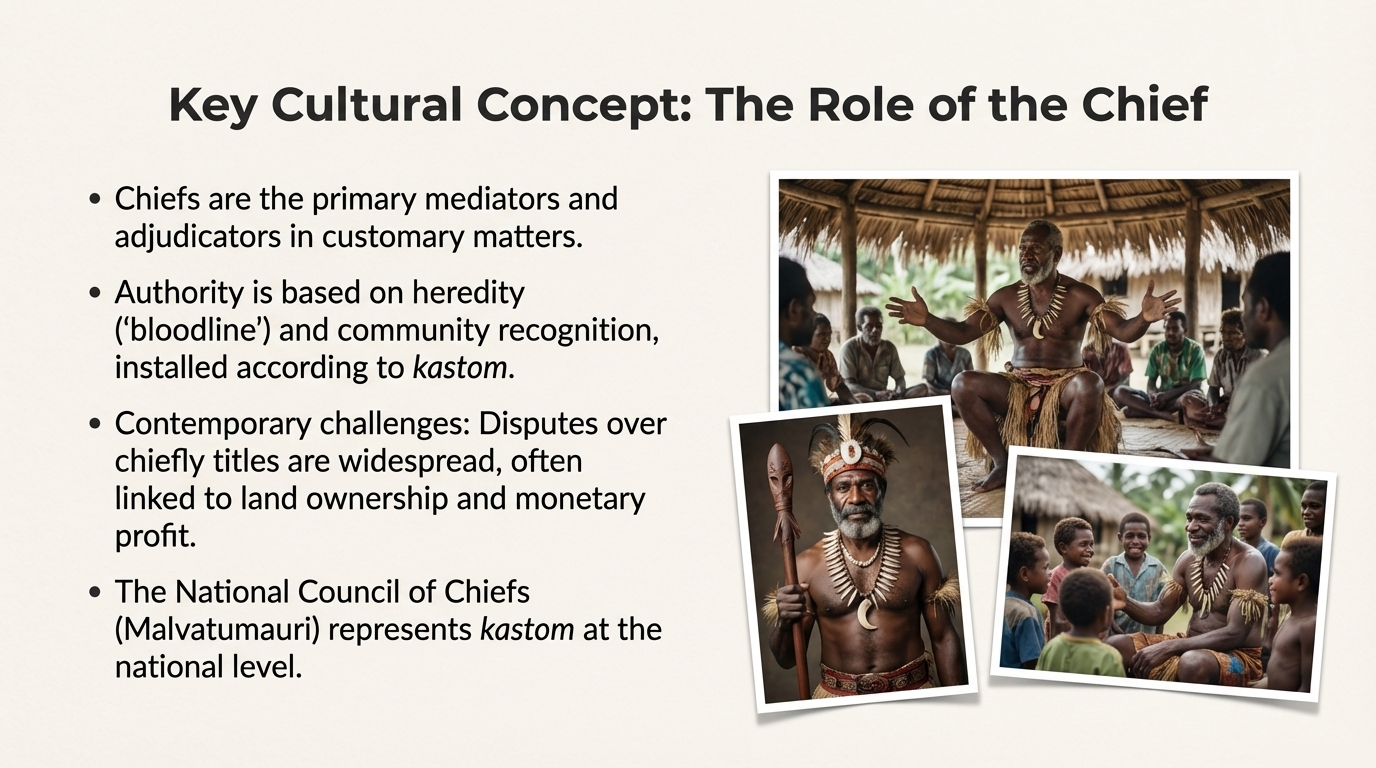
Kastom forums – often held in the nakamal – provide first-line resolution of disputes ranging from minor theft to serious assault. Chiefs and elders act as mediators, adjudicators and spiritual guardians.:contentReference[oaicite:5]{index=5}

Proceedings are typically public or semi-public. They emphasise discussion, acknowledgement of harm, and ceremonial reconciliation. Remedies are framed as compensation and repair – pigs, mats, kava and other items of symbolic value – rather than fines or imprisonment.

Economic change has begun to strain these practices: families who must pay school fees and cash debts may struggle to meet customary obligations. Yet the expectation that conflict will be dealt with in kastom remains strong and shapes how people perceive the legitimacy of any later state action.

  • Objective: restore peace, mend relationships, reintegrate wrongdoers.
  • Process: group-based, story-rich, spiritually aware, with chiefs and elders at the centre.
  • Outcome: reconciliation ceremonies and visible commitments to future harmony.
Illustration of a nakamal meeting with chiefs, elders and villagers gathered in a circle for kastom reconciliation.
Figure 3. Chiefs and elders leading a kastom reconciliation in a nakamal.
4. State system

Courts, accountability bodies and formal ADR

Vanuatu’s Constitution establishes a pluralist legal order that recognises both introduced law and kastom. A small but complex court hierarchy operates alongside Island Courts and land tribunals.:contentReference[oaicite:6]{index=6}

The Court of Appeal, Supreme Court and Magistrates’ Courts handle serious civil and criminal matters, but resources are limited and many judges are non-resident. Island Courts sit closer to communities, applying local custom to minor disputes. Customary land tribunals deal with land – a central source of both identity and conflict.

Formal ADR provisions exist: civil procedure rules permit court-annexed mediation; the Ombudsman Act allows mediated resolution of complaints; and criminal courts can promote reconciliation, including via kastom, before staying proceedings. In practice, these avenues are underused – the report speaks of only a “trickle” of court-referred mediations.:contentReference[oaicite:7]{index=7}

  • Accountability offices (Ombudsman, Auditor-General) often lack the power or follow-through to secure change.
  • Chronic political instability and personalised politics weaken formal oversight.
  • Island Courts and land tribunals form crucial bridges between kastom and state law.
Diagram of Vanuatu’s formal justice system, from Court of Appeal down to Island Courts and customary land tribunals.
Figure 4. The state’s river of justice: courts, accountability institutions and formal ADR provisions.
5. Legal pluralism

Ships in the night – and occasional bridges

Kastom and state law often pass each other “like ships in the night”: each deals with disputes in its own way, with limited synthesis. Yet there are also creative hybrid approaches and some sharp collision points.:contentReference[oaicite:8]{index=8}

Customary law is formally recognised but sits below the Constitution and legislation. Island Courts are directed to apply local kastom, subject to a repugnancy test that excludes customs contrary to written law or “justice, morality and good order”. Higher courts may sit with customary assessors when hearing appeals from Island Courts.

One striking example saw the Supreme Court send a chiefly title dispute back to a nakamal meeting, later adopting the community’s recommendations as its orders – a glimpse of integrated practice. By contrast, in Public Prosecutor v Kota, chiefs who tried to compel an estranged wife’s return in kastom were convicted of inciting kidnapping because they violated her constitutional freedom of movement.:contentReference[oaicite:9]{index=9}

  • Human-rights tensions arise, especially around women’s participation and domestic violence.
  • Proving oral, variable custom in a rules-based common-law court is technically difficult.
  • Belief in sorcery is widespread and rising; the secular state system struggles to address sorcery-linked disputes.
Graphic of two ships passing on dark water while islands show kastom forums and state courthouses, with occasional bridges linking them.
Figure 5. Co-existence, collision and occasional cooperation between kastom and state law.
6. Comparison

Kastom mediation and Western/Australian mediation side by side

For mediators trained in Western models, Vanuatu’s kastom processes can look unfamiliar – even improper – if judged by foreign standards of neutrality, confidentiality and individual rights. The report highlights core contrasts that must be respected rather than “fixed”.:contentReference[oaicite:10]{index=10}

Infographic comparing Vanuatu kastom mediation and Western/Australian mediation across role of third party, communication, process, key concepts and outcomes.
Figure 6. Two models of mediation: kastom in Vanuatu and Western/Australian practice.
Feature Kastom mediation in Vanuatu Western / Australian mediation
Role of third party Chiefs and elders are authority figures rooted in the community. They are not expected to be neutral and may guide or even impose an outcome. Mediators are external and impartial. They manage process only and have no decision-making power.
Communication style Indirect, story-based, often using parables, pauses and ambiguity to protect relationships and save face. Encourages explicit, direct statements of issues and interests to achieve clarity.
Process Public or semi-public, ceremonial and flexible; focused on community participation and ritual repair. Private, confidential and structured into stages; emphasises procedural fairness for the immediate parties.
Key concepts Consensus and participation are social obligations; neutrality and voluntariness are understood in relational terms. Neutrality, voluntariness and confidentiality are core, non-negotiable norms.
Nature of outcome Community-endorsed solutions, often sealed by apology and compensation (pigs, mats, kava) and aimed at restoring harmony. Written agreements that resolve a defined dispute between individuals, often with a legal enforcement pathway.
Underlying worldview Spiritual and holistic, taking account of sorcery, ancestors and the collective well-being of the group. Secular and analytical, focused on tangible issues and interests framed in legal or psychological terms.
7. Practice

Implications for mediators and lawyers

The report urges Western practitioners to move from “expert problem-solver” to culturally aware co-designer: holding their own models lightly, working with local partners and avoiding “white man’s processes” that undermine kastom.:contentReference[oaicite:11]{index=11}

Direct, confrontational communication, formal voting and silence about sorcery can all be experienced as disrespectful or unsafe. Many ni-Vanuatu will protect relationships by withdrawing or falling silent rather than openly challenging a process that feels foreign.

  • Start with relationships. Invest time in building trust and rapport before addressing issues.
  • Work alongside local leaders. Where possible, co-mediate with chiefs or other respected figures.
  • Acknowledge spirituality. Treat references to sorcery or spiritual harm as serious, even where they sit outside secular law.
  • Allow narrative and silence. Let parties tell long stories, use metaphor and sit with pauses.
Practice slide listing risk factors for Western mediators and principles for culturally safe mediation in Vanuatu.
Figure 7. Practical touchpoints for cross-cultural mediation involving ni-Vanuatu parties.
8. Case studies

When kastom and state law meet in real disputes

Case material in the report illustrates both creative cooperation and sharp conflict between the two rivers of justice, particularly around chiefs’ authority, land and women’s rights.:contentReference[oaicite:12]{index=12}

Case study A

Chiefly title dispute and the nakamal

Supreme Court referral to kastom forum

In a dispute over a chiefly title, the Supreme Court referred the matter back to a nakamal meeting of chiefs and community members. The court later adopted the nakamal’s recommendations as its final orders. This shows one pathway for integrated justice: a state court using its authority to endorse an outcome reached through kastom rather than displacing it.

Case study B

Public Prosecutor v Kota

Constitutional rights vs chiefs’ orders

Chiefs ordered an estranged wife to be forcibly returned to her home island, treating the matter as one for kastom discipline. The state prosecuted, and the chiefs were convicted of inciting kidnapping. The court held that their decision breached the woman’s constitutional right to freedom of movement, highlighting the limits of kastom where it conflicts with fundamental rights.

9. Conclusion

Vanuatu’s braided future: strengthening kastom and the state

The report concludes that kastom will remain the dominant everyday justice system in Vanuatu, but there is active debate about reform, integration and the role of chiefs within the national framework.:contentReference[oaicite:13]{index=13}

Proposals from the Malvatumauri (National Council of Chiefs) include stronger recognition of kastom and possible “customary courts”. Government decentralisation policies may give area councils and local chiefs greater formal roles in dispute resolution. Both developments point towards more deliberate weaving of the two rivers rather than their separation.

For external practitioners, success in this landscape depends less on importing a superior technique and more on enabling processes that Vanuatu communities themselves see as legitimate. That means foregrounding relationships, community harmony and spiritual realities, while still engaging carefully with constitutional rights and international standards.

In that sense, Vanuatu offers a powerful case study in how plural legal orders can move, slowly and imperfectly, towards a braided river of justice that honours both kastom and the state.

Braided rivers flowing past Vanuatu islands, symbolising kastom and state law working together.
Figure 8. Towards a braided river of justice in Vanuatu.